Fire Rated Backer Rod UAE: Why PE Backer Rods Fail Civil Defense Requirements
The UAE has spent a decade rewriting the rules of facade fire safety, and for good reason. The country watched fires race up cladding on high-profile towers, learned the lessons, and built one of the strictest facade regimes in the world. Most of the industry has absorbed the headline requirement — combustible cladding panels are out, Fire Rated Backer Rods are in.
But there is a quieter requirement that still catches projects at the worst possible moment: the gaps between the panels.
At Bluedge Structural Systems, we have supplied Fire Rated Backer Rods and supported passive fire protection on UAE facades for over two decades, and the pattern is consistent. Projects rarely fail approval because of the panel. They fail because of what someone put or didn't put in the joint.
What the code actually says about your panel joints
The UAE Fire and Life Safety Code of Practice treats the facade as a system, not a stack of products. That includes GRC and GFRC cladding, which the code addresses alongside ACP and other exterior wall systems. Three points matter for anyone detailing, procuring or installing a facade:
Non-rated fillers are explicitly not permitted.
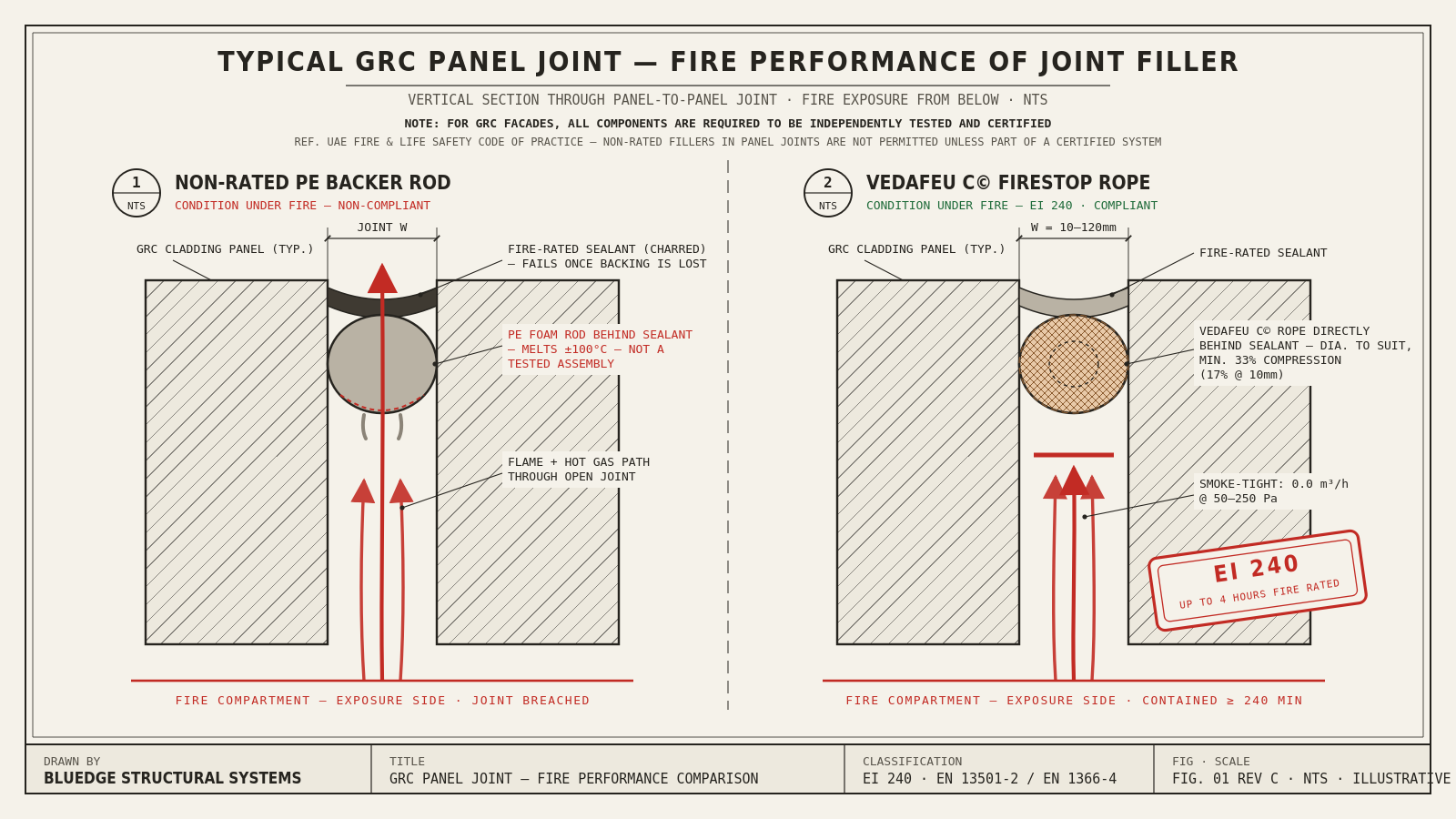
The code does not accept silicone or joint fillers between cladding panels made of non-rated materials unless those materials form part of the certified, tested system. The ordinary polyethylene backer rod sitting behind a bead of sealant on most facades is exactly what this clause targets: PE foam is combustible and softens at around 100 °C — in a fire it disappears, and the "sealed" joint becomes an open slot.
2. Perimeter and joint firestopping must be tested as an assembly.
Where materials close the gap between a fire-rated floor and the facade, the arrangement must be tested and certified as capable of stopping fire, heat, smoke and toxic gases — including vertical flame propagation up the outside of the building. A rated sealant over a non-rated rod is not a tested assembly; it is two products that have never been through a furnace together
3. Everyone in the chain must be registered.
Cladding suppliers and systems must be registered and licensed with Civil Defense, installers must be trained and certified by the system supplier, and a facade fire assessment must be reviewed by a licensed House of Expertise before the facade goes up. Since 1 January 2024, Dubai has gone a step further: cladding materials and facade systems for Dubai projects are tested and certified under the Emirates Safety Laboratory (ESL), whose Certificate of Conformity is the prerequisite for Dubai Civil Defense product registration.
In short: on a modern UAE facade, the joint filler is not a site consumable. It is a regulated fire-safety product, and the approval trail is checked.
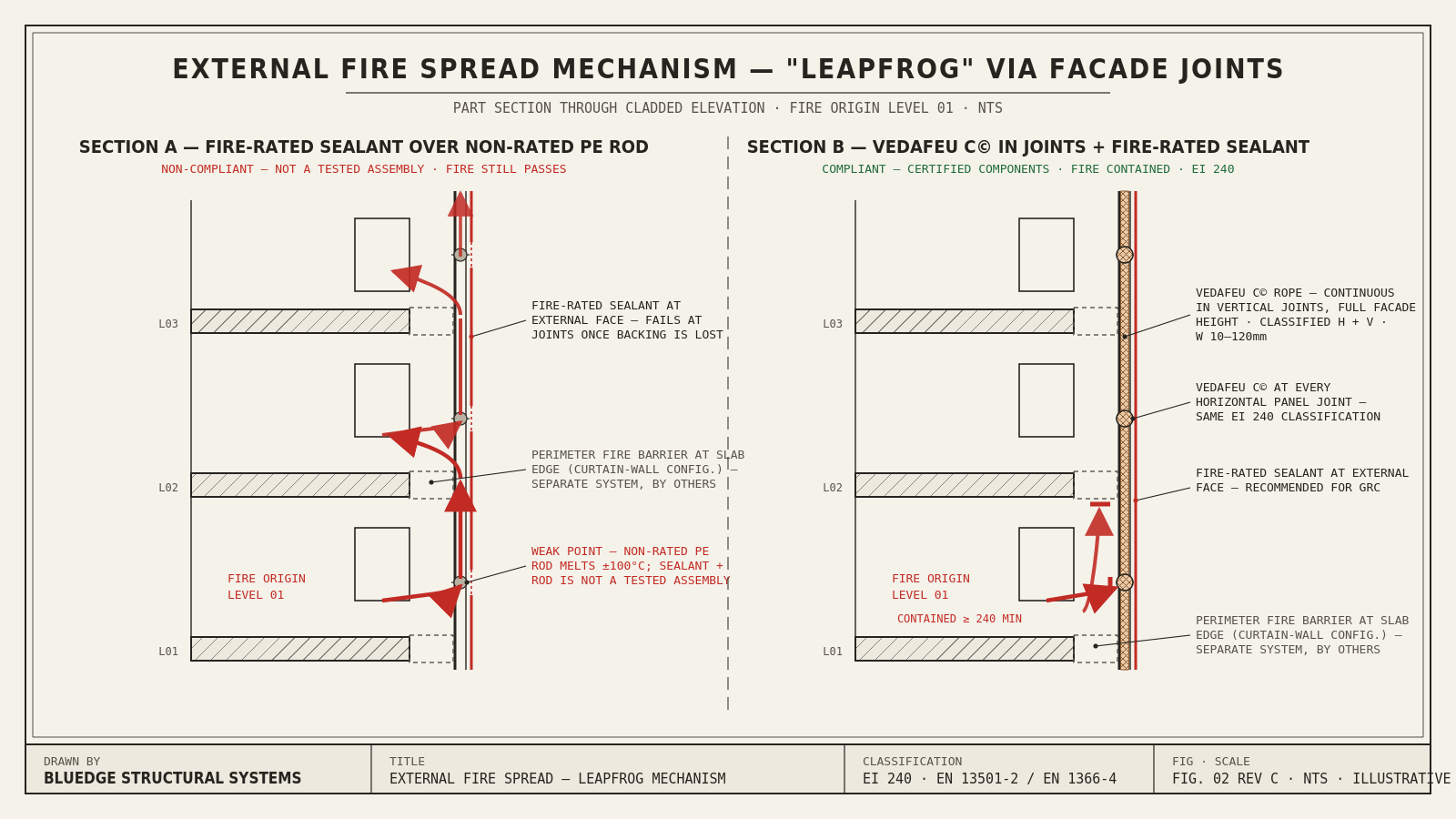
A facade fire doesn't need the panels to burn in order to spread. It needs a path. Unprotected panel joints and open perimeter gaps give fire and smoke a route behind and between the cladding — the "leapfrog" effect, where flames exit a window, re-enter at the floor above, and repeat until an apartment fire has become a full-elevation fire
The UAE knows what this looks like in real life. The Tamweel Tower fire (2012), the Address Downtown fire on New Year's Eve 2015 and the Torch Tower — which burned twice in thirty months — all became case studies in how facades carry fire. The damage in such events goes far beyond the burned floors: residents displaced for months or years, disputes over rebuilding costs, and insurers who now scrutinise facade systems closely and can raise premiums sharply — or decline cover — on buildings with combustible facade details. In 2023, Sharjah went as far as ordering the replacement of hazardous cladding across more than 200 buildings above seven storeys. Remediation at that scale, on occupied buildings, is the most expensive way there is to fix a facade.
And for the project team, the consequences arrive much earlier than any fire. An untested joint detail is one of the most common reasons a facade package attracts comments at the Facade NOC stage. Best case, that's redesign and resubmission. Worst case, the comment lands after panels are installed — and the joints are raked out and rebuilt at height, on programme-critical scaffolding, at the contractor's cost.
The fix: a joint that is the certified fire seal
This is precisely the problem VEDAFEU C© was engineered to solve — and why we brought it to the UAE market.
VEDAFEU C is a firestop rope: a core of rot-proof mineral fibre in a braided fibreglass sleeve, pressed by hand into the joint. It is not a filler hiding behind a sealant. The rope itself is the tested, classified fire seal.
Its firestop performance is measured, not claimed. VEDAFEU C is classified EI 240 — four hours of fire integrity and insulation — to EN 13501-2, tested to EN 1366-4 (classification report n° EFR 20-002698). It is certified for horizontal and vertical joints, exposed or unexposed to fire, in joint widths from 10 to 120 mm, and it accommodates +20% joint movement with compressibility tested up to −85% — essential on real facades that breathe with the Gulf's thermal cycles. It is air- and smoke-tight (0.0 m³/h permeability across 50–250 Pa test pressures), adds acoustic attenuation of 34–40 dB, and its head-of-wall configuration is separately classified EI 180. Testing was carried out by Efectis France, CSTB and CERIB — three of Europe's most respected fire laboratories.
It is certified — and we are precise about what that certification covers. The classification reports cover the rope open-jointed with no sealant, with sealant over the rope, with the VED'EPDM membrane where the joint sees water, with a joint cover, and in head-of-wall — each configuration classified in its own right within the tested support types. For ACP cladding, VEDAFEU C is system-tested and approved with both standard weather sealant and fire-rated sealant. The equivalent GRC-specific system test has not been performed — and this is exactly where the Code's logic matters: the UAE Fire & Life Safety Code requires every facade component to be independently tested and certified, a requirement an EI 240-classified firestop rope meets and a non-rated PE rod never can. For GRC panel joints we therefore recommend the fire-rated sealant configuration, with the joint detail confirmed with your fire consultant and Civil Defence at submittal stage.
It is approved where it matters. VEDAFEU C holds approvals with Dubai Civil Defence and Abu Dhabi Civil Defence, and carries certification through the Emirates Safety Laboratory (ESL) conformity route required for Dubai projects (insert your current certificate/registration numbers here before publishing). When your QA/QC manager compiles the NOC submittal, the evidence pack is ready: classification reports, Civil Defence approvals, method statement, CAD details.
And it is genuinely easy to install. This is the part site teams appreciate most. There are no hot works, no mechanical fixings, and no curing time. The crew cleans the joint, brushes on VEDACOLLE© adhesive, presses the rope in by hand, and splices 2 m lengths with the patented junction. Every diameter is colour-coded, so a supervisor can verify the right rope is in the right joint from the scaffold — quality control by eye. If your installers can place backer rod, they can place VEDAFEU C. The only thing that changes is that the joint now holds fire for four hours.
Getting it right from the start
The cheapest moment to fix a facade joint is on the drawing. Our advice to consultants, GRC manufacturers and cladding contractors is simple: treat the joint as part of the rated facade system from day one, specify a classified joint seal by name, and have the test evidence in the submittal before anyone asks for it.
Bluedge Structural Systems has distributed and supported VEDAFEU C in the UAE for more than 20 years, alongside our wider fire barrier and structural systems portfolio. We hold local stock, we train installation crews, and we provide Technical assistance send us your inquiry, and we will return the required rope sizes , matched to your joint widths.
One rejected NOC costs more than a facade's worth of certified rope. Get the joints right the first time.
Bluedge Structural Systems SP LLC is the UAE distributor of VEDAFEU C© by Veda France. Technical figures are drawn from the manufacturer's classification reports and test data, available on request. Performance figures apply to the tested configurations and validated supports stated in those reports: VEDAFEU C is system-tested for ACP cladding applications with both standard and fire-rated sealants; GRC applications are based on its independent EI 240 component classification in line with the UAE Fire & Life Safety Code, with project-specific joint details subject to fire consultant and Civil Defense approval. This article is general guidance, not a substitute for project-specific fire engineering advice or the current requirements of the authority having jurisdiction.
-
A fire-rated backer rod is a specially engineered fire-resistant material installed within construction and façade joints to help prevent the passage of fire, heat, smoke and toxic gases. Unlike conventional polyethylene (PE) backer rods, fire-rated backer rods are tested as part of fire-resistance assemblies and are intended for applications where passive fire protection is required.
Fire-rated backer rods are commonly used in GRC façades, ACP cladding systems, expansion joints, and fire compartmentation details. In our case VEDAFEU C - Fire Rated Backer Rod
-
The primary difference is fire performance.
A standard polyethylene (PE) backer rod is designed only to support sealants and control sealant depth. It is not intended to resist fire and can soften or melt when exposed to high temperatures.
A fire-rated backer rod is specifically designed and tested for passive fire protection. Depending on the tested configuration, it can maintain fire integrity, limit heat transfer, resist smoke leakage and accommodate joint movement while maintaining the required fire rating.
-
Not necessarily.
A fire-rated sealant alone does not automatically create a fire-rated joint. Fire performance generally applies to the complete tested assembly, including the backing material, sealant, joint dimensions, support construction and installation method.
Using a standard PE backer rod behind a fire-rated sealant does not automatically result in a fire-rated system unless that exact combination has been tested and approved.
-
Façade joints can become pathways for fire, smoke and hot gases during a building fire.
Fire-rated backer rods help maintain the integrity of these joints by providing a tested fire-resistant backing that supports the sealant and reduces the risk of fire spreading through the building envelope.
Properly designed façade joints are an essential part of modern passive fire protection systems.
-
Project approval depends on the complete tested system and the applicable authority having jurisdiction.
Materials used within fire-rated façade joints should be supported by appropriate fire-test evidence and should not compromise the approved assembly. The proposed joint detail should always be coordinated with the project fire consultant and submitted for approval where required.
-
EI240 indicates that a tested construction achieved up to 240 minutes (4 hours) of both fire integrity (E) and thermal insulation (I).
Integrity refers to preventing flames and hot gases from passing through the joint, while insulation limits the temperature rise on the unexposed side during the fire test.
-
VEDAFEU C is a mineral-fibre firestop rope designed for sealing movement joints requiring passive fire protection.
It is classified up to EI240 in applicable tested configurations and is designed to provide fire resistance, smoke resistance, air tightness, acoustic insulation and movement capability within approved joint systems.
-
VEDAFEU C may be specified for GRC façade joints based on its independent fire classification and the project-specific joint detail.
However, it should not be described as a complete GRC-tested façade system unless that exact configuration has been tested and approved. The proposed detail should always be reviewed by the project fire consultant and submitted to the relevant authority for acceptance.
-
Yes.
VEDAFEU C has tested configurations for ACP cladding applications using both weather sealants and fire-rated sealants.
The selected detail should always match the applicable fire-test reports and classification documentation.
-
VEDAFEU C holds the relevant local approvals and certifications applicable to its intended use. Project teams should always verify that the approval documents, registrations and certificates are current and applicable to the proposed installation before submitting the system for approval.
-
Installation generally includes:
Cleaning the joint.
Measuring the actual joint width.
Selecting the correct rope diameter.
Compressing the rope into the joint.
Completing any approved sealant or membrane detail.
Inspecting the installation before handover.
The exact installation procedure should always follow the manufacturer's current method statement.
-
Yes.
Many firestop ropes are designed to accommodate thermal movement, structural movement and construction tolerances while maintaining the required compression and fire performance.
The movement capability should always be verified against the manufacturer's tested data.
-
The correct size depends on:
Actual joint width
Required compression
Expected movement
Fire rating required
We provide sizes suitable for gaps from 5mm up to 120mm.
Typically VEDAFEU C 12; covers gaps up to 12mm, C20 up to 18mm, C30 up to 22mm.
For large façade projects, a detailed joint take-off is recommended to ensure the correct rope diameter is specified for every joint.
-
A complete technical submittal should normally include:
Technical Data Sheet
Civil Defense Approval
Emirates Safety Laboratory documentation (where applicable)
Installation Method Statement
Installation Instructions
Material Safety Data Sheet (MSDS)
-
Specifying the correct fire-rated joint material during the design stage helps prevent redesign, rejected submittals, project delays and costly façade rework.
It also allows consultants, contractors and fire engineers to coordinate joint dimensions, sealants, movement requirements and fire performance before installation begins.
-
In many fire-rated applications, yes.
Where passive fire protection is required, a tested fire-rated backer rod or firestop rope may be specified in place of a standard PE backer rod, subject to the approved system design and project requirements.
Unlike PE backer rods, fire-rated alternatives are specifically developed for fire-resistance applications and can contribute to maintaining the integrity of the joint during a fire when used within their tested configurations.